Buying a 72 inch golf umbrella sounds simple until the wind turns sharply on an exposed fairway. A wide canopy can protect two players, two golf bags, and several clubs. However, extra coverage often brings extra weight, awkward storage, and greater wind resistance. Bigger is not always better.
Golf-equipment reviewer Mark Crossfield has often emphasized practical testing over showroom promises. His advice is simple: “The best golf gear earns its place through real use, not impressive specifications.” That principle matters here. A reliable 72 inch golf umbrella should open smoothly, remain balanced in one hand, and resist turning inside out during sudden gusts. Fiberglass ribs usually offer useful flexibility. A vented double canopy can reduce pressure beneath the fabric. Yet no umbrella is truly storm-proof. That deserves honesty.
This guide examines seven buying points that can prevent expensive disappointment. It considers canopy size, shaft strength, frame materials, handle comfort, opening mechanisms, waterproof fabric, and carrying weight. Imagine standing beside the eighteenth green with wet gloves. A slippery handle becomes a real problem. Picture a crowded cart compartment. A long, heavy umbrella may quickly become inconvenient. Check the closed length before ordering. Review the warranty, too. Small details matter.
Some recommendations may not fit every golfer. A strong player may accept extra weight for wider protection. Another golfer may prefer a lighter model for walking. Personal experience can expose flaws that product descriptions hide. Use these tips as a practical starting point, then question every feature against your course, climate, and playing habits.
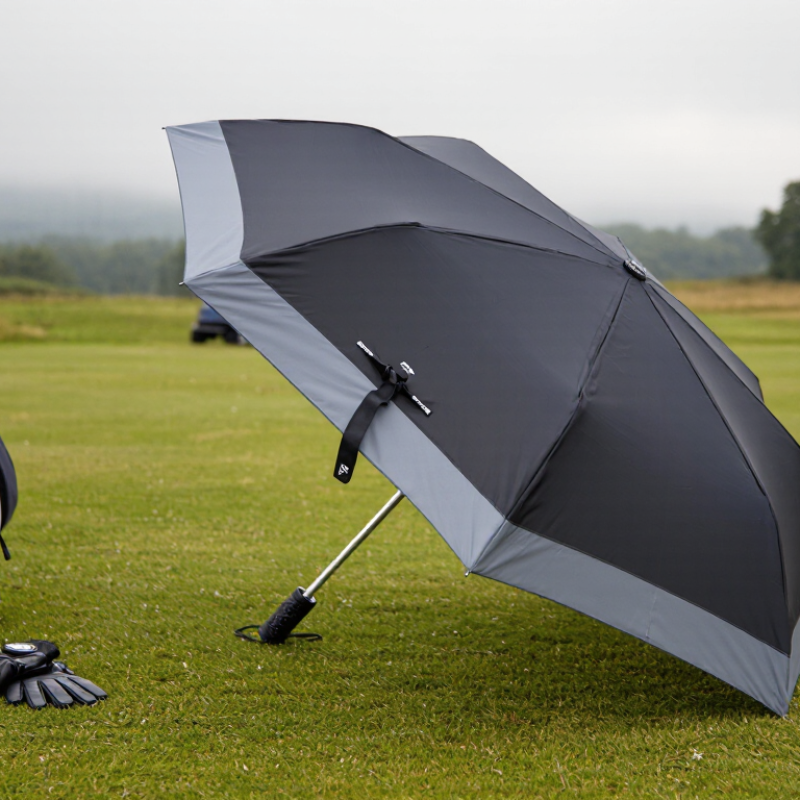
A 72-inch golf umbrella has a six-foot canopy when measured across its straight-line diameter. Using the circle formula, π × 3² equals about 28.3 square feet of theoretical coverage. That is substantial space for one golfer, a cart, or two people standing closely. Real protection is smaller. Wind tilts the canopy, rain enters from the sides, and shoulders often extend beyond the edge. Confirm the seller’s measurement method. Some umbrellas list the curved arc instead of the true span.
Tip 1: Measure your usual gear before buying. Place two golf bags or a cart beneath a six-foot circle. Check handle length, shaft clearance, and packed size. NOAA’s U.S. Climate Normals 1991–2020 show that annual precipitation differs sharply between locations, so local rainfall patterns should guide your choice. A large canopy may feel excessive in dry regions, but useful during frequent showers.
Tip 2: Treat coverage and stability as separate features. The World Meteorological Organization’s State of the Global Climate reports continuing weather extremes, including intense rainfall events. A wide canopy helps with rain, not dangerous wind. Look for a flexible frame, comfortable grip, and a vented design, but do not trust marketing alone.
Tip 3: Test the open canopy indoors first. It should cover your shoulders without striking nearby equipment. I would also recheck the 28.3-square-foot claim; it assumes a perfect circle and full opening, which rarely exists outdoors.
A 72-inch golf umbrella should protect more than your clubs. It should help reduce prolonged sun exposure on the course. Look for UPF 50+ fabric, which blocks at least 98% of ultraviolet radiation. This rating applies to the fabric itself, not every opening or uncovered edge. Check the product’s test report when available. It should identify the UPF result, fabric composition, and testing conditions.
Examine the canopy closely. Tight stitching, overlapping panels, and minimal gaps support more consistent coverage. A dark interior may reduce glare, but color alone does not prove UV performance. Ask whether the fabric maintains its rating when wet or stretched. Outdoor use can change both conditions. The umbrella should also cover two golfers without forcing the canopy too low. That balance matters during a long round.
I once focused too much on size and ignored the handle comfort. It became tiring after several holes. Test the grip, shaft weight, and opening mechanism before buying. Check the ribs and vented sections for wind stability, because a damaged canopy may expose you unexpectedly. A wide canopy can also block peripheral airflow. Consider your course’s typical weather, not just the sunniest forecast. UPF 50+ is valuable, but it works best with shade habits, protective clothing, and regular reapplication of sunscreen. No umbrella removes every risk.
A 72-inch golf umbrella needs more than a wide canopy. Its wind resistance deserves close attention. Choose fiberglass ribs because they flex under pressure instead of bending sharply like rigid metal. This flexibility can help the umbrella recover after a strong gust. On course, that matters.
Look for verified wind-test data. Reliable specifications should name the test speed, testing method, and failure standard. A statement such as “wind resistant” is too vague. Independent laboratory results carry more weight than advertising language. Check whether the test measured rib breakage, canopy inversion, shaft bending, or complete structural failure. Numbers without testing details are not very useful.
Inspect the frame in person when possible. The ribs should connect firmly to the runner, with no loose joints or rough edges. A vented canopy may release pressure through controlled openings. The shaft should feel stable, not excessively flexible. During a rainy round, I have found that a large canopy catches wind like a sail when held too high. Lowering it slightly helped, but it reduced visibility. That trade-off is easy to miss. My earlier choice focused too much on size and too little on balance. A fiberglass frame can still fail in extreme gusts. No umbrella should be treated as storm equipment. Check the manufacturer’s tested limits, examine the warranty terms, and replace any frame showing cracks or permanent distortion.
| No. | Buying Tip | What to Check | Useful Data or Benchmark | Why It Matters |
|---|---|---|---|---|
| 1 | Confirm the canopy size | Verify that the stated 72-inch measurement refers to the open canopy span, not the shaft length or arc measurement. | 72 inches = 6 feet = approximately 182.9 cm. A circular canopy with a 72-inch span covers about 28.3 square feet before overlap and curvature are considered. | A large canopy can shelter more than one golfer, but it also presents a larger area to wind loads. |
| 2 | Choose fiberglass ribs | Look for fiberglass ribs and stretchers, preferably with flexible joints and reinforced connections. | Fiberglass is electrically nonconductive and generally has better elastic recovery than rigid steel when flexed, but material choice alone does not prove wind performance. | Flexible ribs may reduce permanent bending and help the canopy turn inside out rather than break under a sudden gust. |
| 3 | Demand verified wind-test data | Request the test method, wind speed, test duration, sample condition, failure definition, and whether the result applies to the complete umbrella. | A credible report should state wind speed in km/h, m/s, or mph and identify the laboratory or test facility. A marketing phrase such as “windproof” without test details is not verifiable. | There is no single universal wind-resistance rating that applies to every golf umbrella. |
| 4 | Compare the stated wind speed correctly | Check whether the test reports steady wind, peak gusts, or a laboratory airflow value. | For reference: Beaufort force 6 is approximately 39–49 km/h, force 7 is 50–61 km/h, and force 8 is 62–74 km/h. These are weather-scale ranges, not umbrella certification levels. | Wind speed, gust profile, turbulence, and direction can produce different loads even at the same average speed. |
| 5 | Inspect venting and canopy construction | Prefer a double-canopy or vented design with reinforced panel seams, secure rib pockets, and durable stitching. | A vent allows some air to escape through the upper canopy layer; it does not eliminate wind force or guarantee that the umbrella will remain open. | Venting can reduce pressure buildup, while weak seams or rib pockets may still fail first. |
| 6 | Evaluate the frame and joints | Check the shaft, runner, ferrule, rib tips, and opening mechanism for secure joints and smooth movement. | The frame should open fully without rib distortion, loose fasteners, sharp edges, or excessive side-to-side play. | A flexible rib system cannot compensate for a weak shaft, loose joint, or poorly attached canopy. |
| 7 | Balance coverage, weight, and safety | Compare packed length, total weight, handle grip, automatic or manual opening, and safe-use instructions. | A 72-inch umbrella is substantially larger than a typical personal umbrella and may be difficult to control in exposed or crowded areas. | Stop using the umbrella in dangerous conditions, avoid open areas during thunderstorms, and never treat fiberglass ribs as lightning protection. |
A 72-inch golf umbrella offers generous coverage, but size alone does not make it golf-friendly. Before buying, measure the cart’s width and canopy clearance. Open the umbrella beside the cart, not only in your garden. The canopy should protect both players without touching the roof, seats, or nearby clubs. Extra contact can cause awkward handling, especially on windy fairways.
Check the grip length carefully. A long handle may fit comfortably in your hand but interfere with the cart’s umbrella holder or storage area. I once underestimated this detail and had to reposition my clubs around the umbrella. That small mistake became annoying after several holes. Look for a grip that stays secure while leaving room for your hands, scorecard, and equipment.
Two-person use also deserves a practical test. Stand beside another golfer and hold the umbrella at a natural angle. Both shoulders should remain covered without forcing one player to lean outward. A larger canopy may help, yet it can also become heavy during extended play. Confirm the collapsed length before carrying it between holes. If possible, test the umbrella with your actual cart and golf bag. Store it briefly, open it twice, and notice any obstruction. A perfect measurement on paper may still feel inconvenient on the course.
A 72-inch golf umbrella must protect more than one person, so inspect its frame carefully. Open it fully and check whether every rib extends evenly. Loose joints, sharp edges, or uneven tension can signal weak construction. Flexible fiberglass ribs often handle gusts better than brittle materials, but flexibility alone does not guarantee durability. Grip each rib gently. It should feel firm, not hollow or poorly attached.
Look for a vented canopy with an opening near the top. Vents can release trapped air and reduce sudden flipping, especially on exposed courses. Weight also matters. An umbrella that feels extremely light may be tiring to carry, while excessive weight can strain your wrist during a long round. I once chose a lighter model and regretted it after repeated windy sessions. Balance matters more than the number on the scale.
Test the opening mechanism several times before buying. It should operate smoothly without forcing the shaft. Ask how the warranty handles broken ribs, jammed runners, and canopy tears. Read the exclusions carefully. A generous warranty is useful, but unclear coverage creates false confidence. Measure the packed length too. A long umbrella may fit poorly in a golf bag or car trunk. Bring a tape measure if needed. My first inspection missed this detail, and storage became inconvenient. Small checks prevent expensive disappointment.
Update your browser to view this website correctly. Update my browser now