China Best Stainless Steel Door Hinge Manufacturers?

Choosing among China’s best stainless steel door hinge manufacturers requires more than comparing prices or polished catalog images. The real test appears on the jobsite: clean welds, accurate knuckles, smooth pin movement, and doors that remain aligned after thousands of cycles. A reliable supplier should provide material grades, load ratings, salt-spray results, production tolerances, and traceable inspection records. Details matter.

Architectural hardware consultant Lori Greene offers a useful perspective: “Hardware selection is about the entire opening, not one product.” That principle applies directly to Door Hinge Stainless Steel sourcing. A hinge may look strong in a sample box, yet fail when paired with a heavy fire-rated door, an uneven frame, or a corrosive coastal environment. Buyers should examine the complete application, not only the finish.

This introduction will compare Chinese manufacturers through practical criteria, including stainless steel quality, machining accuracy, customization ability, certification support, packaging, lead times, and after-sales communication. It will also consider whether each factory understands commercial, residential, hospitality, and industrial requirements. Factory photographs help, but they are not proof. Independent testing helps more.

There is no perfect shortlist.

Some manufacturers may offer excellent metalwork but weak documentation. Others may communicate well but lack consistent polishing control. That tension deserves attention. A trustworthy Door Hinge Stainless Steel supplier should welcome sample testing, clarify limitations, and explain where its products perform best. Careful buyers should request evidence before making broad claims about “the best” manufacturer.
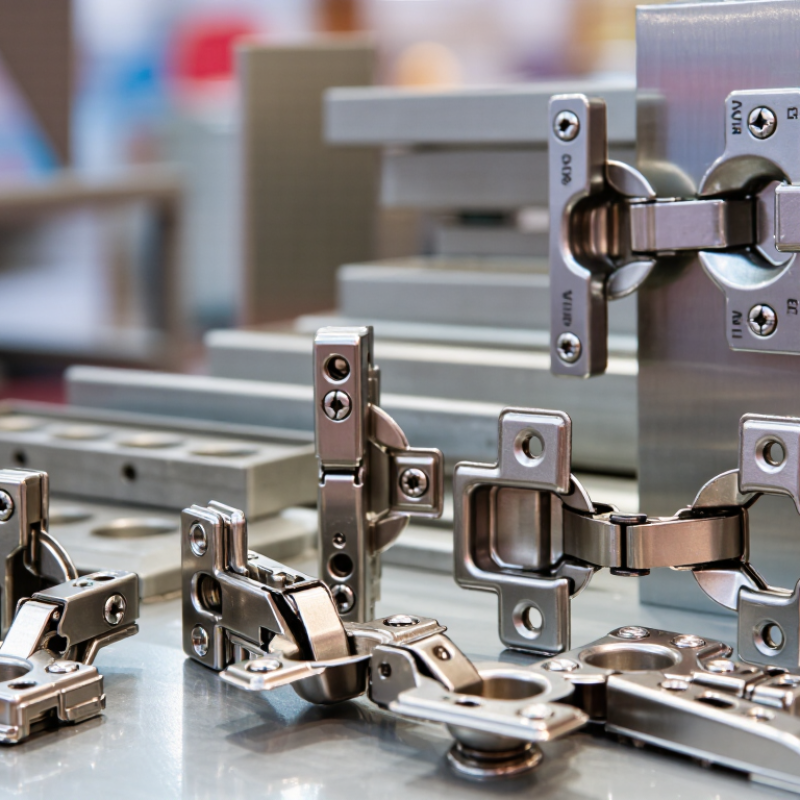
China Best Stainless Steel Door Hinge Manufacturers?

What Defines a Leading Stainless Steel Door Hinge Manufacturer in China?

A leading stainless steel door hinge manufacturer in China proves quality through repeatable engineering, not attractive catalogs. World Stainless reported global stainless steel production of about 58.4 million tonnes in 2023. That scale makes material traceability essential. Reliable factories identify the steel grade, heat treatment, surface finish, and batch number for every shipment.

Professional buyers should examine load testing, cycle testing, and corrosion performance. ISO 9227 salt-spray testing can reveal weak polishing or poor passivation. ASTM F883 also offers useful guidance for hinge performance evaluation. A capable manufacturer shares test records, dimensional tolerances, and inspection photographs without hesitation. It should also provide samples that match mass-production parts. A perfect sample means little otherwise.

Tips: Ask for the mill certificate and inspection plan. Test hinges with the intended door weight. Check screw-hole alignment on a real frame. Review packaging, because scratched surfaces often begin during handling. Suppliers should explain lead times clearly and manage custom drawings carefully. In practice, communication can still fail, even with strong technical teams. That weakness deserves attention. A small tolerance error may create hinge noise, uneven gaps, or premature wear. The best manufacturer therefore combines material expertise, practical testing, transparent documentation, and responsive corrective action. Price matters, but unstable quality costs more over a project’s lifetime.

What Defines a Leading Stainless Steel Door Hinge Manufacturer in China?

Material verification is a key benchmark when evaluating stainless steel door hinge manufacturers. The chart compares the minimum tensile strength and yield strength specified for commonly used 304 and 316 stainless steel grades under ASTM A240 requirements for plate, sheet, and strip.

Both 304 and 316 grades require a minimum tensile strength of 515 MPa and a minimum yield strength of 205 MPa in the referenced condition. A qualified manufacturer should provide material certificates, confirm the selected grade, and validate hinge performance through load, cycle, corrosion, and dimensional testing.

Key Types of Stainless Steel Door Hinges and Their Applications

Stainless steel door hinges serve different purposes, and selecting the wrong type can create noise, sagging, or uneven gaps. Butt hinges remain the common choice for timber, steel, and interior doors. They use two leaves joined by a pin. Stainless steel 304 suits dry indoor areas, while 316 performs better near saltwater, pools, and chemical exposure. Check the door weight, thickness, and daily opening frequency before choosing the size.

Ball-bearing hinges reduce friction on heavy doors. They work well in commercial entrances, fire-rated assemblies, and busy corridors where repeated movement can loosen ordinary hinges.

Continuous hinges distribute weight along the full door height. They are practical for tall doors, security doors, and frames with alignment problems. However, installation must be accurate. A small frame error can affect the entire hinge length.

Spring hinges can close lightweight doors automatically, such as utility rooms and service areas. They need careful tension adjustment, or the door may slam. Concealed hinges provide a cleaner appearance for modern interiors, but they require precise recessing and suitable frame construction. I have seen projects focus too heavily on surface finish and overlook load testing. That mistake becomes visible after months of use. Reliable manufacturing should include controlled welding, smooth knuckles, accurate pin fitting, and corrosion checks. A polished surface looks convincing, but performance depends on the metal grade and internal workmanship.

How Chinese Manufacturers Produce and Test Door Hinges

Chinese stainless steel door hinge production starts with material control, not polishing. Factories typically receive coils or bars, then verify grade and thickness before stamping, CNC machining, or cutting. Portable X-ray fluorescence equipment can check alloy composition within minutes. This matters because the International Stainless Steel Forum reported 58.4 million tonnes of global stainless steel production in 2023. High output does not guarantee consistent quality.

The process continues with deburring, bending, welding, surface finishing, and passivation. Workers inspect pin alignment and bush movement under bright, angled light. A small burr can cause noise or premature wear. Assembly teams also check screw-hole spacing with gauges. Some manufacturers use digital calipers and coordinate measuring machines for tighter dimensional control. The weak point is often simple.

Testing normally combines load checks, repeated-cycle tests, corrosion exposure, and visual inspection. EN 1935 classifies hinge durability, with higher classifications reaching 200,000 test cycles. ISO 9227 provides neutral salt-spray methods for comparing corrosion resistance, but laboratory hours cannot fully reproduce coastal weather. That limitation deserves attention. A reliable factory records batch numbers, test loads, cycle counts, and surface results. It should also retain failed samples for review, rather than quietly removing them. Cost pressure can shorten polishing or passivation time, and buyers may not notice until installation. Independent pre-shipment inspection remains useful, especially for large door projects.

Important Standards, Materials, and Quality Certifications

Choosing among China’s stainless steel door hinge manufacturers requires more than comparing polished samples. Standards reveal whether the hinge can survive real doors, repeated movement, and moisture. EN 1935 classifies hinges by load capacity, durability, corrosion resistance, and fire-door suitability. Its highest durability grade requires 200,000 test cycles. ANSI/BHMA A156.1 offers another recognized performance reference for architectural hinges.

Material selection also deserves close inspection. Grade 304 stainless steel suits many indoor and moderately humid environments. Grade 316 provides better resistance where salt, chemicals, or coastal air are present. The World Stainless Association reported global stainless steel production of about 58.4 million tonnes in 2023. This scale supports broad material availability, but it does not guarantee correct alloy composition. Serious manufacturers should provide heat numbers, mill certificates, and PMI verification records.

Certification needs careful reading. ISO 9001 confirms a quality management system, not automatic hinge durability. ISO 14001 addresses environmental management. For each model, request cycle-test results, corrosion-test records, dimensional drawings, and traceability documents. Factory audits should examine weld finishing, pin hardness, knuckle alignment, and passivation quality. A hinge may look excellent while its pin wears quickly. That is easy to miss. Salt-spray results can also mislead when the test method differs from actual installation conditions. Buyers should match certification evidence with door weight, usage frequency, climate, and installation details.

China Best Stainless Steel Door Hinge Manufacturers? - Important Standards, Materials, and Quality Certifications

Evaluation Dimension Recommended Requirement or Standard Typical Technical Data Verification Evidence Why It Matters
Product Performance EN 1935:2002 for single-axis hinges used on doors and windows Eight-digit classification covering category of use, durability, door mass, fire resistance, safety, corrosion resistance, security, and hinge grade Valid test report, classification report, and traceable product model Provides a recognized method for comparing hinge durability, load capability, and corrosion performance
North American Compatibility ANSI/BHMA A156.1, where the project specifies North American butt hinges Covers dimensions, materials, workmanship, cycle testing, and performance requirements for butt hinges Independent laboratory report or documented test results against the applicable product grade Helps ensure dimensional and performance compatibility with specified doors and frames
Primary Material Stainless steel grades should be clearly identified and supported by material documentation AISI 304 is common for general indoor and many outdoor applications; AISI 316 offers improved resistance in chloride-rich or coastal environments Mill test certificate, chemical composition report, and grade marking or traceability record Prevents substitution of lower-grade steel and supports corrosion-resistance decisions
Material Standards ASTM A240 for stainless steel plate and sheet; ASTM A276 for stainless steel bars and shapes, where applicable Material condition, chemical composition, and mechanical requirements depend on the selected grade and product form Material certificates linked to heat numbers, purchase orders, and production batches Creates a traceable basis for verifying the stainless steel used in hinge leaves, pins, and components
Corrosion Resistance Use a corrosion test suitable for the required market and application; EN 1935 includes corrosion-resistance classification Common finishes include satin, brushed, mirror-polished, or coated surfaces; performance depends on substrate, finish, environment, and maintenance Salt-spray or cyclic-corrosion report stating the test method, duration, specimen condition, and acceptance criteria A finish appearance alone does not prove long-term resistance to moisture, salt, or cleaning chemicals
Load and Door Mass Select a hinge grade and quantity according to the door mass, dimensions, usage frequency, and installation conditions The permitted door mass is product-specific; do not infer capacity from hinge size or stainless steel grade alone Product datasheet, load test report, installation instructions, and declared maximum door mass Reduces sagging, misalignment, premature wear, and fastener failure
Cycle Durability Durability classification should be stated according to the applicable product standard EN 1935 classifies hinge durability using defined test cycles; the required class depends on building type and traffic level Laboratory cycle-test report identifying the exact design, dimensions, load, and test conditions Useful for offices, hotels, schools, hospitals, and other high-frequency applications
Manufacturing Quality System ISO 9001 quality management system certification, preferably covering the relevant manufacturing site and scope Should include control of purchasing, production, inspection, nonconforming products, corrective actions, and records Current certificate issued by an accredited certification body, with site address and certification scope Indicates that documented quality processes are maintained, but it is not a substitute for product testing
Environmental Management ISO 14001 certification for organizations requiring documented environmental management controls Addresses environmental aspects such as energy, waste, chemicals, emissions, and legal compliance Current certificate and defined site scope Supports supplier qualification and environmental procurement requirements
Occupational Health and Safety ISO 45001 certification where responsible sourcing or workplace safety documentation is required Covers occupational health and safety management processes rather than hinge product performance Current certificate, audit status, and site scope Adds evidence of structured workplace risk-management practices
Chemical Compliance RoHS Directive 2011/65/EU and amendments, when the product or project requires restricted-substance compliance; REACH Regulation (EC) No 1907/2006 where applicable Compliance depends on the complete product, including base metal, plating, coating, lubricants, and packaging components Recent third-party screening report, supplier declarations, and material declarations Helps meet restricted-substance and market-access requirements
Dimensional Control Approved drawings should define hinge height, width, thickness, hole positions, corner radius, knuckle size, and pin diameter Critical dimensions should have stated tolerances and inspection methods Controlled drawings, first-article inspection report, and calibrated measuring-equipment records Ensures the hinge fits the door, frame, screws, and preparation details without installation problems
Surface and Workmanship Surface should be free from sharp edges, cracks, excessive scratches, burrs, pits, contamination, and visible polishing defects Finish requirements should define visual limits, surface roughness if necessary, and acceptable color variation Approved samples, inspection criteria, and batch inspection records Improves appearance, handling safety, and consistency across production batches
Pin, Bearing, and Fasteners Component materials and compatibility should be specified separately from the hinge-leaf material Possible configurations include stainless steel pins, plain or ball-bearing designs, and corrosion-compatible screws Component specifications, assembly records, torque checks, and functional inspection results Mixed-metal contact and unsuitable fasteners can cause galvanic corrosion or early mechanical failure
Fire and Smoke Applications Use only when the complete door-set assembly has been tested and approved for the required fire or smoke classification A hinge alone should not be assumed to provide a fire rating; compatibility with the door, frame, seals, and hardware is essential Full assembly test evidence and installation instructions from a competent testing body Prevents incorrect fire-door claims based only on material or appearance
Factory and Supplier Audit Audit production capability, inspection procedures, subcontracted processes, traceability, and corrective-action controls Review raw-material storage, stamping or machining, polishing, assembly, packaging, and final inspection On-site audit report, process flow chart, quality plan, and sample approval records Confirms that certificates and samples reflect repeatable production capability

Note: Certification and test requirements should be confirmed against the destination market, door-set design, application environment, and project specification. A certificate is valid only for its stated holder, site, scope, product, and validity period.

How to Evaluate and Select the Right Chinese Supplier

China Best Stainless Steel Door Hinge Manufacturers?

How to Evaluate and Select the Right Chinese Supplier

Selecting a Chinese stainless steel door hinge supplier requires more than comparing online prices. Request the factory address, production photos, and a live video inspection. Confirm whether the supplier manufactures hinges or only resells them. Ask for material certificates showing the stainless steel grade and thickness. A reliable factory should explain its stamping, welding, polishing, and inspection processes clearly. It should also provide samples from current production, not specially prepared pieces. Small details matter. Check pin alignment, leaf flatness, screw-hole accuracy, and opening resistance by hand.

Test samples under realistic conditions. Use repeated opening cycles, load checks, and salt-spray testing when corrosion exposure is expected. Ask how rejected parts are recorded and corrected. Traceable batch numbers can prevent confusion after delivery. Review the supplier’s quality records, export experience, and response time during technical discussions. Clear drawings should confirm dimensions, tolerances, surface finish, packaging, and inspection standards. I once trusted a smooth sample too quickly; later, inconsistent polishing appeared in bulk pieces. That mistake changed my evaluation process. Do not rely on promises alone. Compare sample results, factory evidence, and communication discipline together. A lower quotation may hide thinner material, weaker pins, or unstable quality. Allow time for corrective samples, because rushed approval can create expensive problems.

Your browser is out of date!

Update your browser to view this website correctly. Update my browser now

×