How to Choose Round Plastic Nursery Pots in Bulk?
Buying round plastic nursery pots in bulk is not simply a search for the lowest unit price. The right choice depends on the crop, growing cycle, watering routine, and available storage space. A pot that looks sturdy in a product photo may flex when filled with wet substrate. Small differences matter.
Maya Chen, a nursery-container sourcing specialist, offers this practical rule: “Match the pot to the crop and workflow before comparing bulk prices.” Check the top diameter, depth, drainage-hole pattern, and rim shape against your plants and filling equipment. For instance, a shallow pot may suit compact plugs, while deeper-rooted crops need more room. Measure a sample beside your existing trays. Do not rely on a label alone.
Plastic type and wall thickness also affect durability, handling, and reuse. Ask suppliers for material details, sample pots, pack quantities, and shipping dimensions. Confirm how many pots fit on a pallet, and whether nested pots separate easily during busy planting days. These details can change the real cost of an order. Annoying, but important.
Bulk buying still involves trade-offs. Thicker pots may last longer, yet occupy more space and cost more upfront. Lighter pots can simplify handling, but may not suit every growing environment. Test a small batch before committing to a large order. Record what works, including what does not. The best round plastic nursery pot is the one that fits your plants, staff, and process—not just your price target.
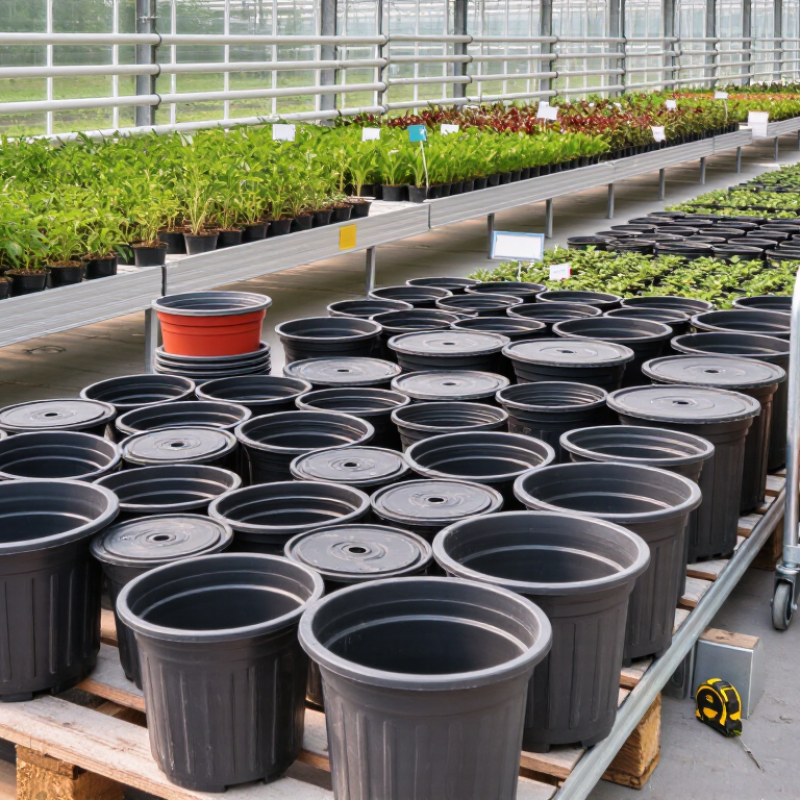
Define Your Growing Needs and Target Plant Types
Before ordering round plastic nursery pots in bulk, identify what you will grow and how long each plant will stay in its container. Shallow-rooted herbs may need less depth than tomatoes or young fruit trees. Measure the root ball, then allow room for new growth without leaving a small plant surrounded by excess wet mix. Pot diameter matters, but depth does too.
Consider your watering routine and growing conditions. A sunny outdoor bench can dry pots quickly, while a shaded greenhouse may keep media damp longer. Check that drainage holes are open and suited to your irrigation setup. For plants with delicate roots, a smooth interior can make removal easier. Tall, top-heavy plants may need wider pots for better stability. Small details count.
Estimate quantities by crop and production cycle, not by guessing from last season’s order. A few sample pots can help you check fit, drainage, and handling before committing to a pallet. Measure twice. It is easy to overestimate uniformity; seedlings rarely grow at exactly the same pace. Record the sizes that work, but review them when varieties, spacing, or watering methods change. Bulk savings are less useful if the pots do not suit the plants.
Compare Pot Sizes, Materials, and Wall Thickness
For bulk orders, compare usable top diameter, depth, and volume, not just the printed gallon size. Trade labels can hide differences between suppliers. A one-inch diameter change may affect bench spacing and root-ball fit. Match pot dimensions to crop age and expected time on the bench; shallow pots dry sooner, while oversized pots can leave growing media wet for longer. Request a dimensioned sample and test it with your trays. Small mismatch, big headache.
Material and wall thickness shape durability. Flexible polypropylene pots are light and easy to handle; thicker or more rigid pots resist crushing during stacking and transport. Ask whether the resin includes UV stabilizers, and compare the same pot after sun exposure, not only fresh from the carton. The US EPA’s 2018 materials report estimated that 35.7 million tons of plastic waste were generated in the United States, with 8.7% recycled. That national figure is not specific to nursery pots, but it makes recycled-content claims worth checking. Ask suppliers for recycled-content documentation and sample consistency. Then inspect rim stiffness, drainage openings, and wall thickness at several points; a single measurement can miss thin spots. I’d still test a small lot first.
Check Drainage, Rim Design, and Stackability
When comparing round plastic nursery pots in bulk, inspect drainage from the inside and outside. Look for multiple open holes around the base, not just one central opening that can sit against a flat bench. Pour water into a sample pot and watch whether it drains freely without pooling. Small details matter. Confirm that hole edges are smooth, since rough openings can catch roots or snag during handling. The USDA National Agricultural Statistics Service reported $18.3 billion in 2022 sales for horticultural specialties, including nursery and greenhouse production. That scale makes consistent pot design important across large orders, although the figure does not measure pot quality.
Check the rim for a firm, even lip that resists bending when staff lift or move filled pots. A rolled rim may be easier to grip, but it should not make pots difficult to separate after stacking. Ask for nested samples and measure the stack height, then test how easily each pot releases. Tapered sides and nesting stops can reduce sticking; inconsistent dimensions can undo those gains. Test a sample first. I would not judge stackability from a catalog photo alone. Compare pots from different cartons, too, because a small variation can become frustrating across a full bench. Include drainage, rim strength, and nesting consistency in the written specification before placing a bulk order.
Assess Supplier Quality and Bulk Order Terms
A bulk quote is only useful when pot quality is consistent across the whole shipment. Check wall thickness, rim shape, drainage openings, and whether nested pots separate without sticking. Ask for a production sample, then compare it with a later batch. A sample can look perfect, yet production may vary; one sample is not proof. Small details matter.
The USDA National Agricultural Statistics Service reported $18.3 billion in U.S. horticultural specialty sales in its 2022 Census of Agriculture. Its 2023 Floriculture Crops Summary put floriculture sales at about $6.7 billion. These figures show the scale of the market, not nursery-pot defect rates. Use them as context, not as a quality guarantee. Ask suppliers for written resin specifications, recycled-content documentation where relevant, and inspection records. Get samples first.
Read the bulk terms line by line. Confirm minimum order quantity, units per carton, pallet layout, freight charges, lead-time range, and how shortages or damaged pots are handled. Request a written tolerance for color and dimensions, plus a clear replacement or credit process. For outdoor use, ask whether UV stabilization is specified and how it is verified. Compare delivered cost per usable pot, not just the unit price. A low quote can hide extra freight or difficult-to-stack cartons. Check the fine print.
Calculate Total Costs, Storage, and Delivery Needs
When comparing round plastic nursery pots in bulk, look beyond the price per pot. Add freight, packaging, pallet fees, and any charges for liftgate delivery or limited-access locations. A low unit price can become expensive when cartons ship in small quantities. Ask for carton dimensions, pot count, and loaded pallet height before ordering. Space adds up. Measure your storage area, including doorways and aisle turns, then check whether nested pots can be stacked safely. Leave room to reach the bottom cartons without shifting the whole stack. Measure twice.
Delivery planning depends on more than the arrival date. Confirm the carrier’s estimated window, unloading requirements, and whether your site has a dock or forklift. If pots are needed for a planting schedule, allow time for delays and a quick count on arrival. A spreadsheet can still miss awkward details, like a pallet that will not fit through a shed door. Build a small buffer into the order, but avoid buying more than your dry, shaded storage can protect. On receipt, check for cracked rims, warped bases, and mismatched sizes before distributing pots to work areas. These checks take a little time. They can prevent a larger scramble later.
Bulk Round Nursery Pot Cost Breakdown
Example planning estimate for 5,000 pots: pot purchase at $0.18 each, plus estimated delivery, storage, and handling costs. Confirm unit prices, pallet dimensions, storage requirements, and freight charges with your supplier before ordering.