Top Glass Condiment Bottle Manufacturers for Global Buyers

A Glass Condiment Bottle must do more than look attractive on a shelf. It should pour cleanly, seal reliably, and withstand repeated handling. For global buyers, the choice of manufacturer affects product protection, lead times, customization, and landed cost. Small details matter. A cap that leaks during transit can undo careful work on a sauce’s recipe and label.

The market context is substantial. FEVE’s Glass Packaging Circular Economy report, using 2020 data, puts the EU glass packaging recycling rate at 80.1%. That figure reflects a mature recovery system, but it does not guarantee that every bottle will be collected or remade. As FEVE Secretary General Adeline Farrelly has emphasized, glass is “100% and endlessly recyclable.” Buyers should still check recycled-content options, bottle weight, and the supplier’s documented quality controls. Circularity depends on real systems.

This guide compares leading glass condiment bottle manufacturers for international procurement. It considers production capacity, mold development, closure compatibility, export experience, and communication during sampling. Ask for samples filled with your own product. Check how a narrow-neck bottle pours olive oil, or whether a wide-mouth jar releases thick chutney without a mess. These tests reveal issues that a catalog image cannot. And specifications deserve scrutiny: “food-grade” alone does not explain testing methods or tolerances. Supplier claims should be verified against current technical documents and sample performance. The shortlist is a starting point, not a substitute for due diligence.
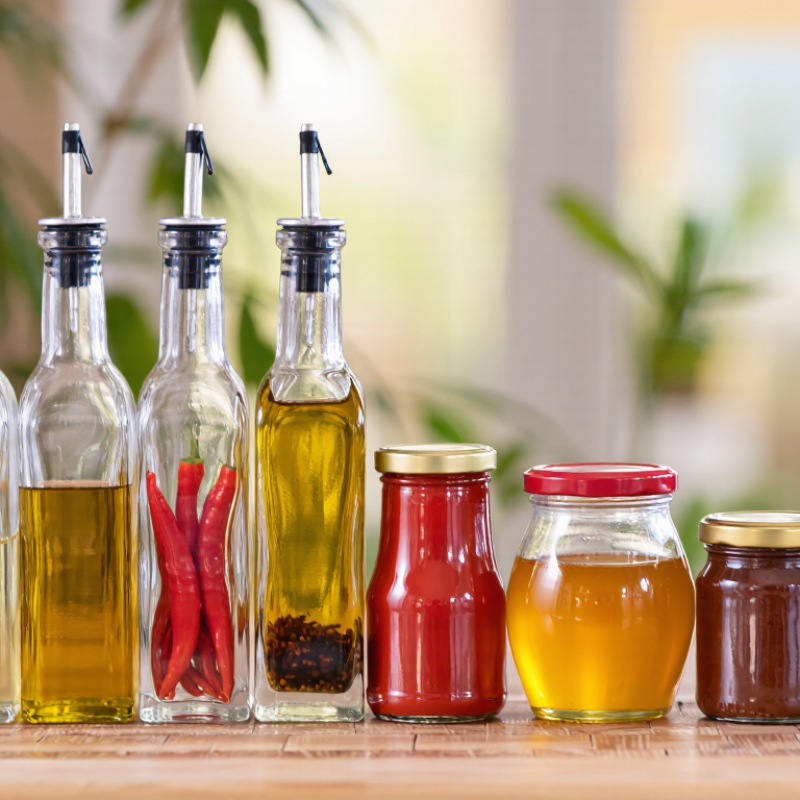
Top Glass Condiment Bottle Manufacturers for Global Buyers

Understanding the Global Glass Condiment Bottle Industry

The global glass condiment bottle industry connects raw-material suppliers, glassmakers, closure producers, and food packers. Buyers compare more than appearance. Capacity, neck finish, glass weight, and closure fit affect filling speed and shelf performance. A bottle designed for thick sauce may not pour well with thin vinegar.

Details matter. Ask for production samples and dimensional drawings before confirming an order. Check that caps, liners, and dispensing inserts match the bottle finish. Color also deserves attention: amber glass can reduce light exposure, while clear glass shows the product and any sediment. These choices depend on the condiment and how customers use it.

Manufacturing conditions vary across regions. Energy costs, furnace capacity, transport distance, and seasonal demand can influence availability and delivery schedules. Request information about quality checks, defect limits, and batch traceability, then review samples under realistic filling conditions. A bottle may pass visual inspection yet behave differently on a fast production line. That can be frustrating. Regional packaging requirements also differ, so buyers should verify applicable specifications with qualified local advisers. No single design suits every market; even a small change in shoulder shape can affect labeling and packing.

How Glass Condiment Bottles Are Made and Designed

Glass condiment bottles begin as a carefully prepared mixture of sand, soda ash, limestone, and recycled glass. In a furnace, the batch melts into a glowing liquid. Forming machines shape it inside metal molds, then controlled cooling helps reduce internal stress. The bottle is inspected for cracks, uneven walls, and rough openings. Small defects matter. A tiny flaw near the neck can affect pouring or sealing.

Design is more than appearance. A narrow opening can control drips, while a wider mouth makes filling easier. Shoulders, grip texture, and bottle weight also affect handling on a busy kitchen counter. Clear glass shows the condiment’s color; tinted glass can limit light exposure, depending on the product and storage conditions. Closures must fit the finish precisely, and samples should be tested with the intended cap and contents. A shape that looks elegant in a drawing may feel awkward when wet. That part is easy to overlook.

Tips: Check the bottle’s capacity, opening, and base stability with a filled sample. Test pouring at different angles. Leave room for labels and production tolerances; perfect drawings do not always make perfect bottles.

Top Glass Condiment Bottle Manufacturers for Global Buyers - How Glass Condiment Bottles Are Made and Designed

Manufacturing or Design Area How It Works Common Options or Considerations What Buyers Should Check
Glass composition Many food and beverage containers are made from soda-lime-silica glass, formed from a batch that commonly includes silica, soda ash, and limestone. Clear glass shows the product; amber and green glass can reduce exposure to some light wavelengths. Confirm that the glass is suitable for the product, intended storage conditions, and applicable food-contact requirements.
Batch preparation and melting Raw materials are proportioned and mixed, then melted in a furnace. Recycled glass, known as cullet, may also be included in the batch. Batch composition and cullet use depend on the glass formulation, product requirements, and manufacturing process. Ask for material and food-contact documentation relevant to the destination market and intended use.
Bottle forming Molten glass is cut into measured portions called gobs. A forming machine shapes each gob in a mold to create the bottle. Press-and-blow and blow-and-blow are established forming methods; the suitable method depends on the container design and production requirements. Review samples for shape consistency, finish quality, base stability, and compatibility with filling and capping equipment.
Annealing Newly formed bottles pass through an annealing lehr, where controlled cooling helps reduce internal stresses in the glass. Cooling conditions are managed as part of the production process and vary with the glassware and line setup. Request the supplier’s inspection and process-control information, especially for bottles that will face filling or handling stresses.
Capacity and dimensions Bottle capacity, height, body shape, and neck dimensions are established in the product design and checked during production. Common design choices include straight-sided bodies, rounded shoulders, and different neck or opening sizes. Specify fill volume, brimful capacity if required, dimensional tolerances, and the available space on the filling line.
Neck finish and closure The neck finish is formed to work with a compatible closure and sealing system. Options can include screw finishes and other closure-compatible designs; the right choice depends on the cap, liner, and dispensing needs. Test the bottle with the exact closure and liner. Check fit, sealing performance, and opening or dispensing requirements.
Dispensing design The opening and neck can be designed around the condiment’s flow behavior and the intended way of serving it. Wide openings can support thicker products or easier filling; restricted openings or inserts can help control pouring when compatible with the product. Evaluate pour rate, clogging risk, product residue, cleaning needs, and user handling with the actual condiment.
Decoration and labeling Branding and product information may be applied using labels or glass-decoration methods such as screen printing. Decoration choices affect appearance and may influence minimum order quantities, lead times, and recycling considerations. Confirm artwork, label dimensions, adhesive suitability, print durability, and required market information before production.
Quality inspection Manufacturers can inspect appearance and key dimensions and use checks suited to the bottle design and production process. Inspection plans may cover cracks, chips, finish defects, capacity, dimensions, and performance requirements agreed with the buyer. Agree on acceptance criteria, sampling procedures, defect definitions, and any testing required for the intended filling and distribution conditions.
Packaging and shipment Glass bottles are packed to limit movement and contact damage during storage and transport. Packaging format depends on bottle shape, shipment method, and handling requirements. Review the packing method, pallet configuration, protective materials, and shipment inspection process before placing an order.

Regions and Manufacturers Serving Global Buyers

European manufacturers often suit buyers seeking precise neck finishes, stable color, and documented recycled-content practices. Asian production hubs offer broad capacity and varied decoration options, while North American suppliers can simplify regional replenishment. These are tendencies, not guarantees; factory capability varies widely. MarketsandMarkets estimated the global glass packaging market at USD 65.7 billion in 2023, with a projected value of USD 82.9 billion by 2028. The report covers glass packaging broadly, not condiment bottles alone, so buyers should treat it as market context rather than a bottle-specific forecast.

For a practical comparison, request samples with the intended cap and test them on filling equipment. Check bottle weight, thread dimensions, breakage rates, minimum order quantities, and mold ownership. Ask for current food-contact documentation and clarify which production site will fulfill the order.

A quote is not a qualification. Freight matters, too: glass is heavy, and a distant low unit price may be offset by transport costs or longer replenishment cycles.

One detail is easy to miss: decoration can affect lead time as much as bottle production. Confirm print colors and approval steps early. Regional sourcing helps, but supplier claims still need verification.

Comparing Suppliers by Quality, Customization, and Compliance

Comparing glass condiment bottle manufacturers starts with repeatable quality, not a polished sample alone. Check bottle weight, wall thickness, neck finish, and base stability across several production samples. Small details matter. A cap that fits one sample may loosen on another. Ask suppliers how they control dimensional variation and whether they can provide inspection records or batch traceability.

Customization can include bottle shape, capacity, glass color, embossing, and closure options. Request production drawings and confirm which changes affect tooling cost, minimum order quantity, and lead time. Ask for a pre-production sample filled with a product similar to yours; oil, vinegar, and thick sauces can behave differently during pouring. No shortcut works. Color matching may also shift slightly between batches, so agree on acceptable limits before ordering.

Compliance depends on the destination market and the bottle’s intended use. Request current food-contact declarations, test reports, and material specifications, then check that the documents match the exact bottle and closure being purchased. Ask who conducts testing and how often records are updated. Verify requirements with your importer or a qualified compliance specialist. Paperwork can look complete while leaving practical questions unanswered. Compare suppliers on response quality, production controls, customization limits, and evidence—not price alone.

How to Select and Source a Glass Bottle Manufacturer

Top Glass Condiment Bottle Manufacturers for Global Buyers

Selecting a glass bottle manufacturer starts with the product, not the catalogue. Define the fill volume, sauce viscosity, dispensing style, and closure type. A narrow neck may suit oil, while a wider opening helps with thick dressings. Details matter. Ask for drawings that show capacity, dimensions, neck finish, and glass weight. Confirm that the proposed closure fits the bottle you will actually order.

Request samples from the intended production process, then inspect them under normal filling conditions. Check for leaks, uneven bases, rough seams, and caps that need excessive force. A sample can still mislead. Production batches may vary, so ask how the supplier monitors dimensions and defects. Discuss minimum order quantities, tooling charges, lead times, and packing methods in writing. Request carton specifications and, where practical, review drop-test results.

For export orders, clarify which food-contact documentation and testing apply in the destination market. Keep approved samples and specifications as reference points for repeat orders. Communication is part of quality. Notice how clearly the manufacturer handles revisions, complaints, and delivery updates. A low quote may exclude protective packaging or inspection costs. It is easy to miss those details. Compare complete landed costs, and leave room for a pilot order before committing to larger volumes.

Your browser is out of date!

Update your browser to view this website correctly. Update my browser now

×