China’s Gramophone Record Player industry brings together long-established audio factories, specialist turntable makers, and brands serving export markets. Their products can look similar in a catalog, yet differ in details that shape daily listening: platter weight, tonearm adjustment, cartridge compatibility, motor noise, and the feel of the speed controls. Small details matter.
Thomas A. Edison, whose early phonograph helped establish recorded sound, wrote, “The phonograph will undoubtedly be liberally devoted to music.” That prediction still feels relevant, though today’s buyers also weigh setup, repair support, and consistent quality. A polished cabinet is appealing, but it cannot tell you how quietly a motor runs or how carefully a tonearm tracks a record.
This Top 10 guide introduces Chinese manufacturers and offers a practical framework for comparing them. It considers product range, manufacturing experience, technical specifications, customization options, and available after-sales information. These factors can help buyers ask better questions before requesting samples or quotations. Not every brand publishes the same level of detail, and a ranking cannot reflect every room, budget, or listening preference. I may give too much weight to specifications; real use can reveal other differences. Still, clear comparisons are a useful place to begin.
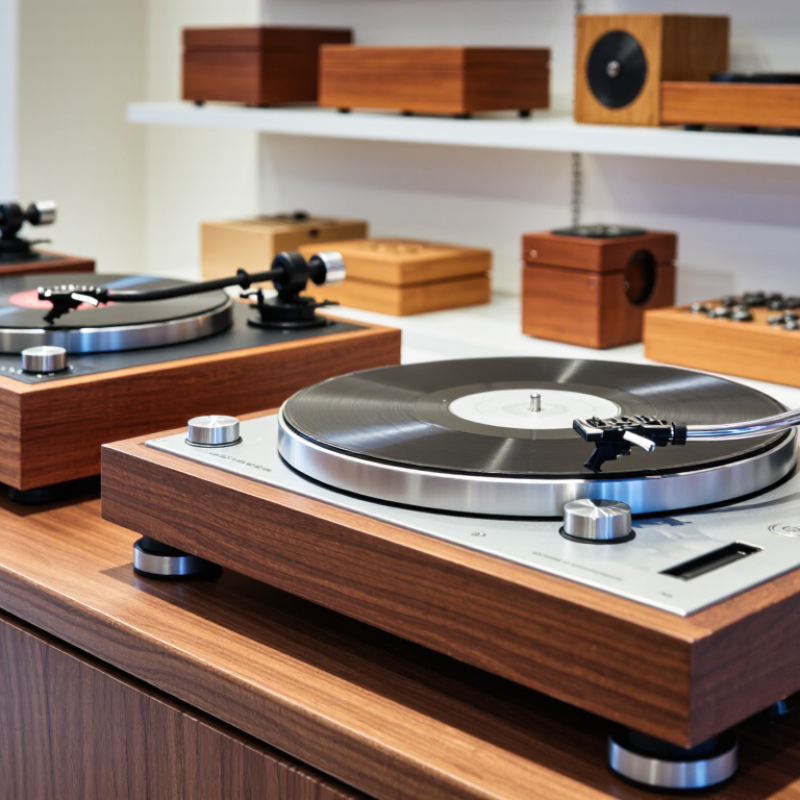
China’s gramophone record player manufacturing industry combines traditional cabinet work with modern audio engineering. Production may involve wooden housing, metal turntables, drive motors, tonearms, and electronic speed controls. These parts often come from different suppliers, so coordination matters. A smooth-looking cabinet is only one part of a dependable player. Details matter.
Manufacturers typically assemble components, adjust platter speed, and check tonearm movement before shipment. Practical quality checks can include listening for motor noise, testing the output connection, and confirming that the platter starts consistently. Small differences in alignment or vibration may affect playback. The picture is not uniformly polished: finishing quality and inspection depth can vary between factories and production runs.
For buyers assessing suppliers, clear specifications are more useful than broad claims. Ask about supported record speeds, cartridge compatibility, replacement parts, and how products are tested. Requesting sample units can reveal issues that photographs miss, such as a loose hinge or audible hum. Not every supplier documents these checks equally well. That gap deserves attention. The industry’s strength lies in its broad manufacturing network, while consistency still depends on careful sourcing and practical verification.
A credible top-ten ranking should compare factories using verifiable production and quality evidence, not polished catalogues. We assess manufacturing experience, export history, documented inspection procedures, component sourcing, and capacity to handle repeat orders. Not glossy photos. Auditors should inspect assembly benches, wiring, platter balance, packaging, and sample-test records. The IFPI Global Music Report 2024 recorded a 6% rise in global vinyl revenue in 2023. That growth signals renewed demand, but it does not prove any supplier’s performance. Each candidate still needs independent checks.
Technical review should examine speed stability, wow and flutter, rumble, tonearm movement, and cartridge alignment. Sample units should be tested under consistent conditions, then checked again after transport. Small details matter. We also compare warranty terms, spare-part availability, response times, and clear defect-handling procedures. A supplier’s certificates can support a review, but they cannot replace product testing or a factory visit. One limitation remains: public data rarely separates record-player output from broader audio production. Rankings therefore need to disclose where evidence is incomplete and avoid treating sales claims as verified capacity.
This framework explains how candidates can be assessed and ranked. The weights below are proposed editorial criteria, not published ratings for specific companies.
| Selection Criterion | Weight | What Is Evaluated | Evidence to Review |
|---|---|---|---|
| Verified manufacturing capability | 20% | Evidence that the business operates or directly manages production for record players, rather than acting only as a reseller. | Factory information, production-process descriptions, equipment lists, and consistency between product and manufacturing documentation. |
| Product engineering and range | 15% | Coverage of relevant product configurations, such as belt-drive or direct-drive systems, manual or automatic operation, and integrated or external phono preamps. | Current product specifications, manuals, component details, and documented model variations. |
| Quality management and testing | 15% | Documented procedures for incoming-material checks, assembly inspection, functional testing, and handling of defects. | Quality-process records, inspection plans, test procedures, and valid quality-management certificates where provided. |
| Market-specific compliance readiness | 12% | Ability to provide documentation relevant to the electrical, radio, chemical, and product-safety rules of the intended destination market. | Applicable declarations, test reports, labeling information, and product documentation. Requirements depend on product configuration and destination market. |
| Production capacity and delivery planning | 10% | Ability to explain production capacity, order scheduling, material availability, and realistic lead-time estimates. | Written capacity information, sample production schedules, and clear explanations of standard versus peak-season lead times. |
| OEM and customization capability | 8% | Support for buyer-specific requirements such as finishes, packaging, accessories, manuals, or product specifications. | Customization scope, minimum order quantities, sample-development process, tooling terms, and change-control procedures. |
| Warranty and after-sales support | 7% | Clarity of warranty terms and the process for troubleshooting, replacement parts, and product claims. | Written warranty conditions, service-contact procedures, spare-parts information, and claim-response process. |
| Supply-chain traceability | 5% | Ability to identify key components and suppliers and to communicate material or component changes. | Component specifications, supplier-control procedures, and records of approved substitutions where available. |
| Commercial and export experience | 5% | Readiness to manage international orders, export documentation, packaging requirements, and shipment coordination. | Sample commercial documents, export-process details, packaging specifications, and references that can be independently checked. |
| Information transparency | 3% | Accuracy and completeness of product, company, and transaction information supplied during evaluation. | Consistent specifications, responsive answers, verifiable business details, and clear quotation and payment terms. |
| Total weighting | 100% | Weights represent the proposed selection method. | |
Scoring method: Score each criterion from 0 to 5 using the evidence available, multiply the score by its weighting, and add the weighted results. Shortlist candidates with verifiable manufacturing capability and relevant product documentation before ranking them. Missing evidence should be recorded as unverified rather than assumed.
The ten profiles are best read as a capability-based guide, not a verified ranking. Manufacturer 1 focuses on turntables for home listening, where stable speed and low motor noise matter. Manufacturer 2 emphasizes belt-drive designs, often pairing simple controls with replaceable components. A practical detail: check how easily the belt can be accessed. Manufacturer 3 appears oriented toward OEM production, supporting custom finishes and packaging for overseas buyers.
Manufacturer 4 specializes in entry-level models with built-in speakers, while Manufacturer 5 targets users who prefer separate amplifiers and passive speakers. Manufacturer 6 highlights tonearm adjustment and cartridge compatibility; these specifications deserve close review. Manufacturer 7 serves compact, decorative designs, where appearance may take space from service access. That trade-off is easy to miss. Manufacturer 8 concentrates on direct-drive mechanisms, which can suit frequent use but require careful vibration control.
Manufacturer 9 offers a broader product range, from basic playback units to feature-rich systems with USB output. Manufacturer 10 focuses on component sourcing and assembly consistency. Ask about inspection procedures, replacement parts, and sample testing before placing a large order. Details vary by model. Product sheets alone may not reveal long-term reliability, and some specifications need independent confirmation.
Chinese gramophone record player manufacturers offer several product types, from compact suitcase players to wooden console units. Many factories also produce belt-drive and direct-drive models for home listening or entry-level DJ use. Details matter. A hinged lid, metal tonearm, and felt platter mat can change daily handling more than a decorative finish.
Common features include built-in stereo speakers, Bluetooth reception, USB output, and adjustable speed settings for 33⅓, 45, or 78 rpm records. Some models use ceramic cartridges for simpler assembly, while higher-spec designs may support replaceable magnetic cartridges. Buyers should check tracking-force adjustment, cartridge availability, and whether the USB port records or only plays files. These distinctions are easy to miss in a short product sheet.
Manufacturing capabilities vary widely. Larger facilities may handle cabinet machining, injection molding, circuit assembly, and final testing under one roof; smaller suppliers may rely on partner workshops. Ask for sample inspection records, speed-stability results, and packaging drop-test details. Fit varies. A factory can build to a drawing, yet tonearm alignment or speaker vibration may still need refinement after a pilot run. Clear specifications and a physical sample make comparisons more reliable than catalog photos alone.
When comparing Chinese gramophone record player manufacturers, look beyond cabinet style and catalog photographs. Ask for a current specification sheet covering platter speed, tonearm design, cartridge compatibility, and available outputs. Then compare the details against a physical sample. Does the platter rotate steadily? Is the tonearm easy to balance? Listen for motor hum at normal volume. Small details matter.
Request evidence of quality checks, not just general assurances. A useful factory report may show speed measurements, inspection records, and packaging tests. Ask how the manufacturer checks units during production, and whether the same components will be used in your order. Component changes can affect sound and reliability. Check the wood finish, hinges, and controls closely; these are easy to overlook in a video call.
Service matters too. Review the written warranty, spare-parts availability, and response process for defects. Request a production sample if practical, then compare it with later units. A polished sample can hide uneven batch quality. One inspection cannot prove everything, and I would treat vague answers as a reason to ask more questions, not as proof of poor quality. Price is only one part of the comparison.
A practical specification to check when comparing manufacturers is supported record speed. These are the three commonly used nominal vinyl record playback speeds.
Check each product’s specifications against the records you plan to play. Records intended for 78 RPM may also require a compatible stylus; speed support alone does not guarantee compatibility.
Update your browser to view this website correctly. Update my browser now